
Baldur’s Gate 3 never shies away from letting love curdle into heartbreak. Across its sprawling three‑act campaign, romance bubbles up during campfire chats, stolen glances, and shared peril, but every budding relationship can be shattered by a deliberate choice, a failed roll, or a permanent death. Among the cast of deeply written companions, Shadowheart’s romance arc offers a warmth that makes its darkest terminus all the more chilling. Long after the game’s blockbuster 2023 launch, players still dissect that one decision—handing her over to Viconia DeVir—as the cruelest possible ending for a lover who had dared to break free from Shar’s shadow. It is not simply a breakup; it is an obliteration of identity, memory, and the very person the player fell for.
Shadowheart’s questline is one of the most detailed in the game, forking according to whether she remains a loyal acolyte of the Lady of Loss or rediscovers her original Selûnite self. The Selûnite path—generally seen as her “good” ending—requires the player to help her defy her former cloister and embrace the moon goddess. By the time the party confronts Viconia in the House of Grief during Act 3, Shadowheart has already wrestled with a lifetime of manipulation, reclaimed fragments of her past, and possibly fallen in love. So when the option appears to surrender her to Viconia in exchange for avoiding a brutal fight with the Sharrans, the weight of that choice is staggering. Few companions are presented with a moment where the protagonist can volitionally discard them not out of necessity, but as a transaction. Doing so permanently removes Shadowheart from the party; she becomes an absent NPC, a ghost stationed in the Sharran Lookout who no longer knows who she is.
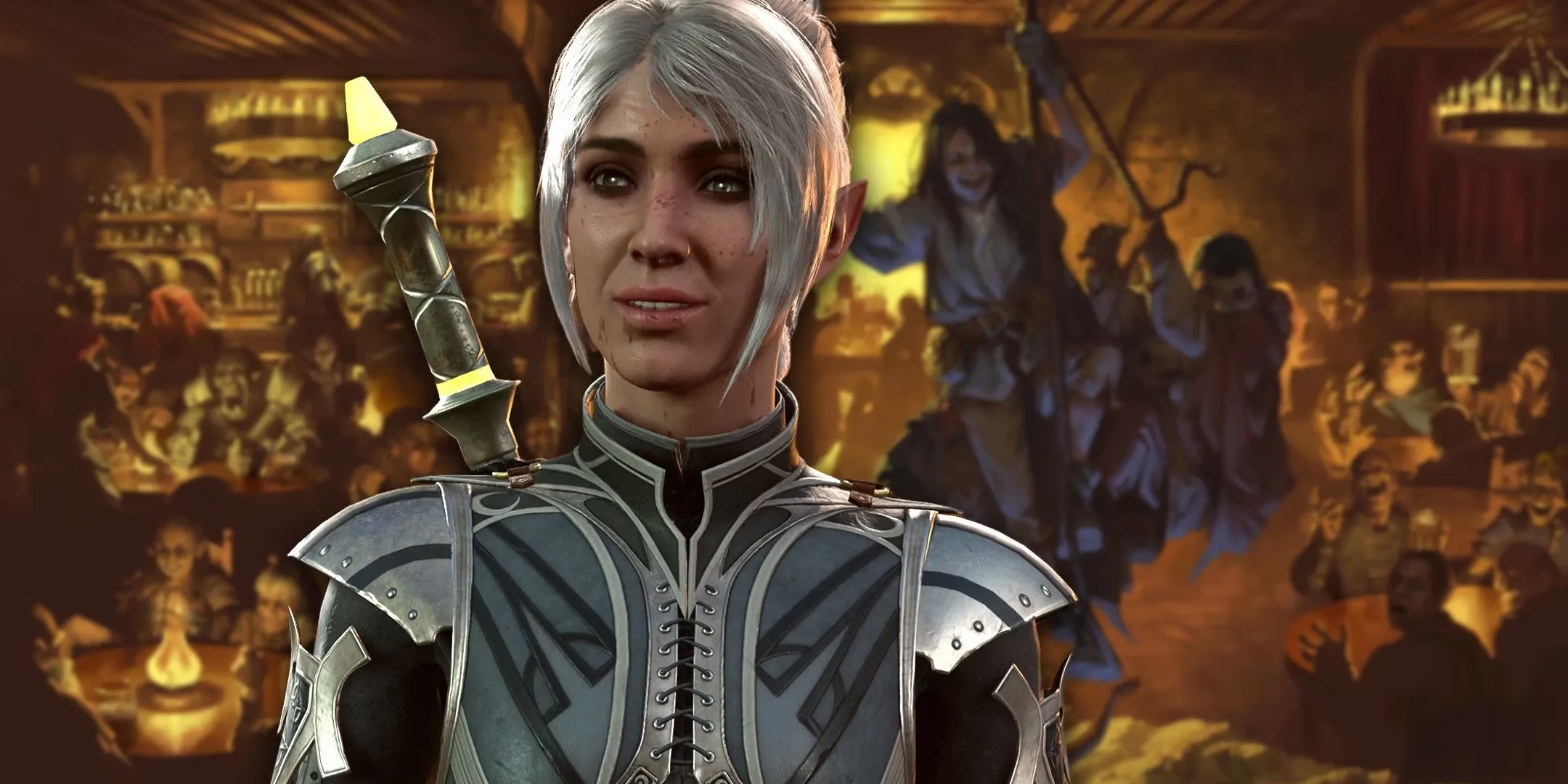
What makes this ending so uniquely vicious is the complete memory wipe that follows. Shadowheart’s arc begins with her own amnesia—a blank slate compelled by Shar’s doctrine—and throughout the campaign she painstakingly pieces together truth from manipulation. To give her back to Viconia is to undo all that struggle in a single, quiet moment. Should the player later visit the Sharran Lookout, they find Shadowheart alive, healthy, and utterly empty. She does not recognize her former friends, her lover, or even a night orchid, the flower that once symbolized the tenderness she was capable of. The game’s Narrator coldly confirms that the tadpole connection yields only a pristine void; there is no hidden spark of recollection, no secret roll to bring her back. Trying to remind her of a past romance elicits nothing but a dismissive insult. She stands there, a hollow shell wearing a familiar face, completely severed from every shared campfire confession and every stolen night.
This outcome feels far more painful than many of the other tragic romance terminations in Baldur’s Gate 3. Consider Gale’s potential sacrifice to destroy the Netherbrain: it is heroic and devastating, but he at least leaves behind a holographic farewell and the knowledge that his death meant something. Shadowheart’s fate offers no such catharsis. She does not die a martyr; she is erased and repurposed by the cult she dared to leave. The romance does not end in a blaze of sorrowful glory—it ends with the lover becoming a stranger, still within arm’s reach but forever unreachable. The game does not even grant the player the mercy of a final goodbye. Instead, it forces them to witness the result of their betrayal: a version of Shadowheart who mocks their memories by simply not having them.
Even from a pure mechanical standpoint, the decision feels jarring. The fight against the Sharrans is challenging, certainly, but by Act 3 a well-prepared party can manage it. The option to surrender Shadowheart seems less like a strategic necessity and more like a narrative test of cruelty—a deliberate inclusion to remind players that this role‑playing sandbox allows them to be monstrous. And the monstrous act is punished not with a dramatic cinematic, but with a lingering, understated horror. The companion who once tentatively opened up about her fear of wolves, who shared her first genuine laugh, continues to exist in the world as a vacant echo. For a player who invested dozens of hours cultivating that bond, the Sharran Lookout becomes the loneliest room in Baldur’s Gate.
In the years since the game’s release, Shadowheart’s memory‑wipe ending has remained a benchmark for emotional devastation in modern RPGs. It transcends a simple “bad ending” by attacking the very foundation of the relationship: the shared history that makes the love feel real. Many games kill off a romantic interest; few erase the love altogether while forcing the player to watch the loved one carry on without them. In 2026, new generations of adventurers still approach that fateful dialogue with Viconia and hesitate, knowing full well that the cruelest option is not a bloodbath—it is a quiet, irreversible betrayal that leaves Shadowheart alive, but gone forever.