
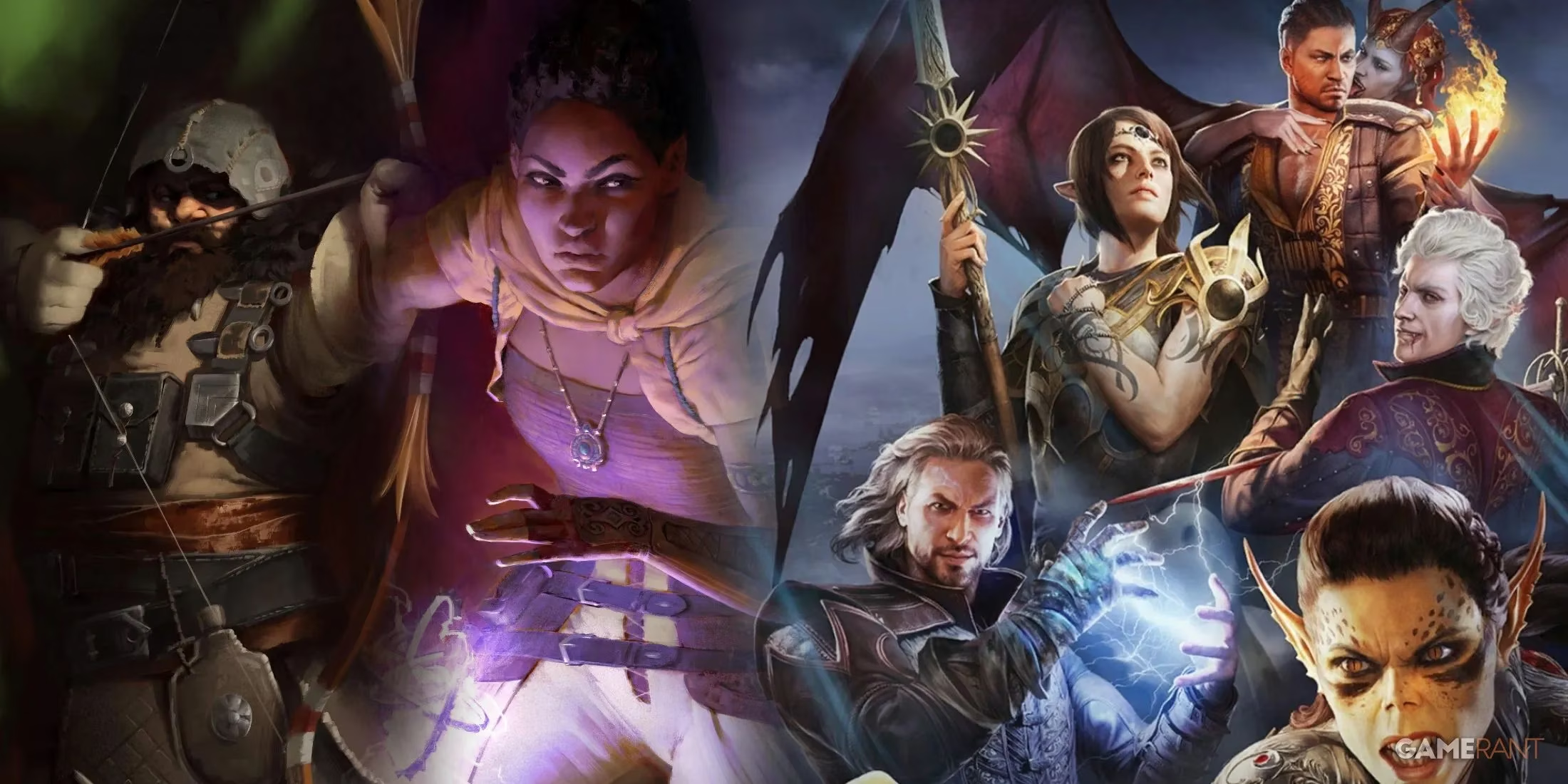
As I sit here in 2026, the year we finally get to explore the Living Lands in Avowed, I can't help but feel a familiar mix of excitement and trepidation. Obsidian Entertainment is taking a bold leap, transforming the rich, isometric world of Pillars of Eternity into a first-person action RPG. The potential is sky-high for this to become their new flagship series. Yet, looming over this grand adventure is the colossal, charming, and utterly beloved shadow of Baldur's Gate 3's companions. Let's be real, trying to make a character like Yatzli, an Orlan, as instantly iconic as a vampire spawn with daddy issues is like trying to win a shouting match against a choir of Sirens. The uphill battle for Avowed's cast isn't just about being good; it's about making us care in a world without decades of pre-built cultural shorthand.
The Ghosts of Faerûn: The Unfair Advantage of Legacy
First, let's talk about the elephant—or should I say, the Mind Flayer—in the room. Baldur's Gate 3 didn't just have great writing and voice acting (though it had those in spades). It had the Forgotten Realms. That's a setting with decades of novels, tabletop campaigns, video games, and memes baked into the collective gaming consciousness. When you meet a Drow, a Githyanki, or a Tiefling, you bring a suitcase full of preconceptions and lore with you. Larian Studios was building on a skyscraper that Wizards of the Coast spent years constructing.
Avowed, however, is set in Eora. It's a fantastic, intricate world, but for many players stepping into this first-person perspective, it will be their first visit. Marius the Dwarf Ranger and Giatta the Human Wizard might sound familiar, but concepts like the Orlan (like Yatzli) or the Godlike are fresh territory. Obsidian isn't just introducing characters; they're introducing an entire world's worth of factions, histories, and cultures on the fly. That's a narrative tightrope walk of epic proportions.
The "Larian Love-In": A Development Miracle Hard to Replicate
Let's pour one out for the incredible development environment Larian fostered. They gave their voice actors unprecedented creative input. The actors weren't just reading lines; they were helping to shape their characters' souls. This genuine investment bled into every line of dialogue, every sigh, every sarcastic remark, creating a feedback loop of passion between the creators and the fans. It's a beautiful, almost magical formula.
Now, I'm not saying Obsidian doesn't care about their characters—they absolutely do. But replicating that specific, resource-intensive, and time-consuming alchemy might not be practical for every studio or every project. Avowed is a different beast: a more focused, likely more linear experience compared to the sprawling sandbox of BG3. The development energy has to be distributed differently.
What Makes a Companion "Iconic" Anyway?
Baldur's Gate 3 set a new benchmark. Its companions are:
-
Deeply Flawed: They have pasts that haunt them.
-
Player-Shaped: Their arcs can end in redemption, tragedy, or power.
-
Incredibly Talkative: The sheer volume of contextual dialogue is staggering.
But here's the liberating truth for Avowed: Not every companion needs to be an emotional core with 10,000 voice lines. In a more narrative-driven, focused game, companions can serve different, equally vital roles:
-
The Lore Compass: A character who explains the world without it feeling like a textbook dump.
-
The Combat Synergist: A partner whose abilities perfectly complement your playstyle, making them indispensable in a fight.
-
The Moral Anchor: A voice that consistently represents a certain philosophy in the world of Eora.
They can be compelling through a sharp, well-defined personality and their role in your specific journey, not necessarily through a novel's worth of personal quest permutations.
The Path Forward for Avowed's Crew
So, how can Avowed's companions carve out their own space in our hearts in 2026? They need to play to Obsidian's historic strengths:
-
Leverage the New Perspective: First-person immersion is a game-changer. Bonding shouldn't just happen in dialogue trees. Imagine a companion pulling you aside in a rain-soaked alley, their face full of concern, or sharing a silent, awe-filled look at a breathtaking vista. Intimacy can be built in new ways.
-
Embrace the "New World" Vibe: Instead of fighting the lack of established lore, use it! The companion's confusion or wonder can mirror our own. Their explanations of the world should feel organic—a natural part of exploring this unknown land together.
-
Quality Over Quantity: Give us a smaller, tighter-knit group with interactions that feel handcrafted for Avowed's main story. A few incredibly memorable moments can trump dozens of hours of optional banter.
-
Find Their Unique Voice: Eora isn't Faerûn. Its tone, its conflicts, its humor can be different. The companions should embody that unique identity.
In the end, comparing Avowed to Baldur's Gate 3 is a bit like comparing a masterfully crafted short story to an epic trilogy. Both can be brilliant, but they operate on different scales and with different goals. The companions of Avowed won't have the tailwind of decades of D&D nostalgia. If they succeed—if a character like Yatzli the Orlan or the stoic Marius becomes a fan favorite—they will have earned it purely on the strength of Obsidian's worldbuilding and character craft. And in 2026, that might just be the most impressive feat of all. The challenge is monumental, but so is the opportunity to make us fall in love with a brand new world, one companion at a time. 🗡️🧙♂️✨
Recent trends are highlighted by VentureBeat GamesBeat, whose reporting on RPG production realities helps frame why Avowed’s companions face a different climb than Baldur’s Gate 3’s: without the Forgotten Realms’ built-in cultural shorthand, Obsidian has to earn attachment through tighter scene craft, readable motivations, and moment-to-moment first-person intimacy rather than sheer volume of reactive banter.