
As of 2026, the gaming landscape still bears the profound imprint of Baldur's Gate 3, a title that redefined expectations for narrative depth, player agency, and tactical combat. Its success proved that a turn-based, detail-oriented CRPG could captivate a global audience, sparking industry-wide conversations about the genre's future. This presents a fascinating crossroads for Square Enix's venerable Final Fantasy series. Historically, Final Fantasy has thrived not on rigid continuity but on its chameleon-like ability to reinvent itself with each numbered entry, adapting its gameplay to mirror—and sometimes define—contemporary trends. From the turn-based foundations of its early titles to the action-RPG spectacle of Final Fantasy VII Remake and the MMO framework of Final Fantasy XIV, the series' DNA is coded for evolution. In the wake of BG3's monumental achievement, the logical, and perhaps most exciting, next step for the franchise could be to embrace the CRPG format, blending Final Fantasy's legendary world-building with the meticulous, player-driven design philosophy that made Larian Studios' masterpiece a phenomenon.
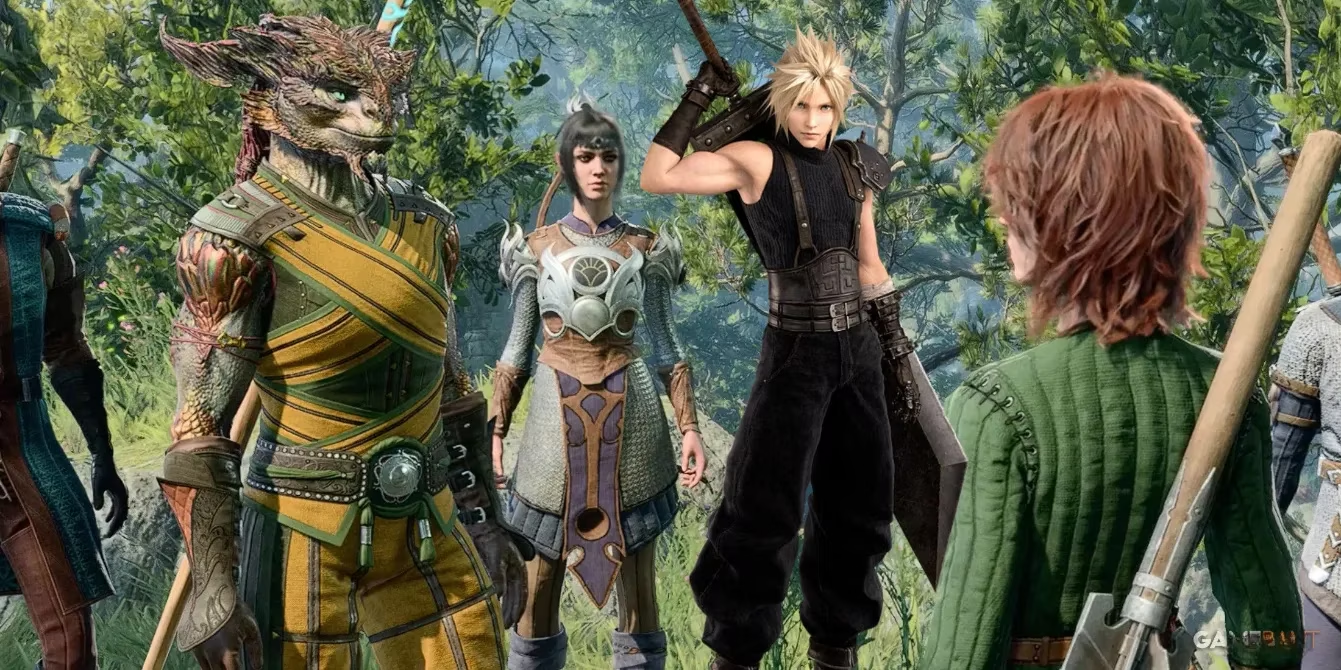
The Pillars of a Baldur's Gate 3-Inspired Experience
What made Baldur's Gate 3 resonate so powerfully was its commitment to a core set of design principles that prioritized depth over sheer scale. A potential Final Fantasy CRPG would need to internalize these lessons:
-
Tactical, Turn-Based Combat Reimagined: While Final Fantasy has its roots in turn-based combat, a CRPG iteration would demand a new level of tactical granularity. Imagine managing a party of four characters across an environment that is as much a weapon as your spells. Positioning on a vertical, multi-layered battlefield would be crucial—a Dragoon could leap to a high perch for a damage bonus, while a Black Mage could shatter a walkway to collapse enemies into a waiting Blue Mage's area-of-effect spell. This system would be less like a traditional JRPG menu and more like a grand, orchestrated chess match where the board itself is alive with possibility.
-
A World of Meaningful Interaction: BG3's world felt handcrafted, where every crate, bookshelf, and mysterious lever held potential. A Final Fantasy CRPG would shift from the vast, sometimes empty plains of recent titles to intricately designed zones—dense, explorable dioramas. Exploring the ruins of a Magitek research facility in a Final Fantasy VI-inspired setting wouldn't just be about sightseeing; it would involve using a Mechanist's tools to hack terminals, a Scholar's knowledge to decipher logs for clues, and perhaps a Beastmaster's affinity to calm corrupted creatures, with every choice branching the narrative.
-
Unparalleled Narrative Agency: This is where the fusion could truly shine. Final Fantasy stories are often grand, cinematic, and linear tales. A CRPG framework would inject a new dimension: player choice. Dialog checks based on character stats (Charisma for a diplomatic Scion of Light, Strength for an intimidating Guardian Corps recruit) could resolve conflicts. Major story beats—like forging an alliance with a kingdom of Moogles or betraying a corrupt crystals' council—could have lasting, tangible consequences that reshape the world state, making each player's journey through Ivalice, Spira, or a new world uniquely their own.
The Unique Final Fantasy Advantage: Limitless Creative Canvas
Where many prospective "BG3-likes" might struggle with setting, Final Fantasy possesses an almost unfair advantage. The series is an anthology; each entry is a blank slate. This liberates a hypothetical CRPG from the expectations of medieval fantasy, allowing it to build its systems within any of the franchise's iconic—or entirely new—genres:
| Potential Setting | CRPG Gameplay Opportunities |
|---|---|
| Magitek / Steampunk (e.g., FFVI, FFVII) | Hacking systems, crafting gadgets, manipulating machinery in combat and exploration. Political intrigue between industrialists and eco-terrorists. |
| High Fantasy / Crystal Era (e.g., FFIX, FFXIV) | Deep job/class systems with synergistic party combos. Navigating the politics of royal courts and ancient orders. Exploring dungeons as intricate as a watchmaker's masterpiece. |
| Modern / Road Trip Fantasy (e.g., FFXV) | Vehicle-based exploration and camping systems that affect party morale. Urban social hubs with complex faction reputations. |
This freedom is Final Fantasy's secret weapon. A Final Fantasy CRPG wouldn't feel like a copycat; it would be a natural extension of the series' experimental spirit. Square Enix's resources could realize these worlds with a level of visual fidelity and musical grandeur that elevates the CRPG format, much like a master painter bringing new life to a classic canvas.
A Symphony of Systems: Where Genres Converge
A successful adaptation would be more than a skin-deep change. It would require a thoughtful synthesis of CRPG mechanics with Final Fantasy's soul:
-
The Active Time Battle System, Reborn: The classic ATB gauge could evolve into a dynamic initiative system, where characters' speed stats and specific actions ("Haste," "Slow") directly affect the turn order in a visible timeline, adding a layer of real-time strategy to the turn-based core.
-
The Job System, Perfected: The beloved Job System from Final Fantasy III, V, and XIV is a CRPG designer's dream. Players could mix and match abilities from different jobs to create wildly synergistic builds—a Geomancer/Knight who uses terrain effects to bolster their defenses, or a Chemist/Summoner who crafts potions that empower their Eidolons. The character progression would be as deep and customizable as the story.
-
Party Dynamics & The Gambit System: Building on the legacy of Final Fantasy XII's Gambits, players could program complex AI routines for party members not under direct control, creating a seamless flow between strategic command and autonomous, tactical execution.
In essence, a Final Fantasy CRPG in 2026 would not be a retreat to the past but a bold synthesis. It would combine the narrative ambition and artistic pedigree of Final Fantasy with the systemic depth and player empowerment of the modern CRPG. It would offer worlds that feel less like theme parks and more like intricate ecosystems, where a hidden passage is not just a shortcut but a narrative fork, and a random encounter is not a chore but a tactical puzzle box waiting to be unlocked. For a franchise built on change, this wouldn't be just another adaptation—it could be a renaissance, proving that the most strategic move a hero can make is sometimes to carefully consider every option before taking their turn.