
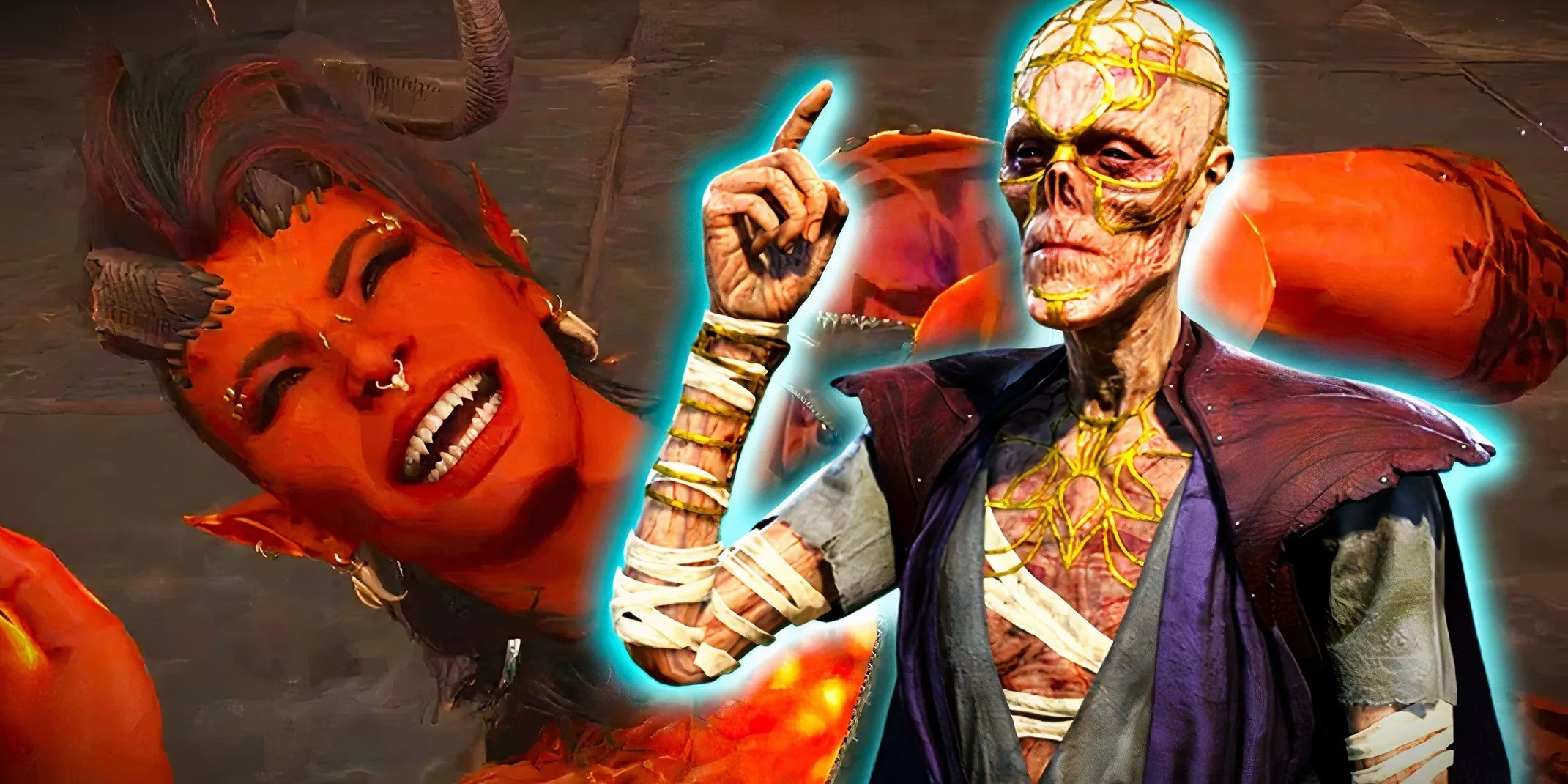
In the twilight-lit camp, where the scent of campfire smoke mingles with whispers of ancient prophecies, there dwells a being older than memory—Withers, the skeletal scribe who holds the threads of destiny in his bony fingers. He offers a peculiar gift: the chance to unweave the very fabric of one's being and knit it anew. By 2026, with Baldur's Gate 3 fully blossomed and Patch 8 long embraced by the community, adventurers have twisted this power into a play of pure whimsy. They have taken the companions they love and draped them in the most ill-fitting mantles, crafting tales so absurd that the Weave itself nearly chokes on laughter. What follows is not a guide to optimization, but a poetic ode to these marvelous misfits—a gallery of souls forced into cosplay that defies every fiber of their personality.
The Bookworm’s Rage: When Gale Forgets His Manners
Picture, if you will, the most erudite wizard of Waterdeep, a man who courts the goddess of magic with sonnets and meticulously polished spellbooks, suddenly stripped of his robes and thrust into a berserker’s harness. Gale, as a barbarian, is a storm trapped in a teacup, a metaphor that the game itself seems to relish. When the fury takes him, his roar is not the throaty bellow of a seasoned warrior, but a polite, startled yelp—like a librarian who has had his quill snapped. The developer’s hidden sense of humor winks through this performance, leaving players to muse on the irony of a Netherese orb pulsing inside a man who now chooses to solve problems with his fists rather than Fireball. Indeed, every object he smashes carries a silent apology, and every enemy felled feels the faint sting of a lecture on proper conduct. Oh, the spectacle! A barbarian who still memorably muses that a well-timed rage might just be a "vigorous physical refutation." You can almost hear the Ancestors of his Wild Magic subclass rolling their eyes.
The Ranger Who Feared Her Own Shadow
Shadowheart, the cleric veiled in mystery, tiptoes through her own story haunted by the howls of wolves. To make her a Beast Master ranger is to orchestrate a divine comedy of errors. Imagine this half-elf stepping into the moonlight, a devoted Selûnite at last, and summoning a spectral wolf to fight by her side. The creature materializes, loyal and fierce, yet its mistress recoils, her heart racing not with the thrill of battle, but with that old, childlike terror. The game itself stays silent on this inner turmoil, but every player who tries it will fill the void with nervous giggles. Is it cruelty or a strange kind of therapy? One might argue it’s a trial by fur—a rite of passage where Shadowheart must command the very embodiment of her nightmares. In a softer light, after the brain has fallen and cottage life beckons, a Swarmkeeper ranger version of her appears: a gentle soul calling forth bees instead of spirit guardians, turning her home into a buzzing sanctuary. Speak with animals here would be less an interrogation of prey and more a tea-party with woodland diplomats. The juxtaposition is so sweetly ridiculous that even the wolf would swap its growl for a confused whimper.
The Vampire’s Vegan Dilemma: Astarion Among the Vines
Ah, Astarion. The pale elf who prowls the night with a silver tongue and a taste for trouble. Reclass him as a druid, and the universe performs a masterclass in situational irony that the game itself can’t help but tease. There exists a delicate, fully voiced scene in which the spawn learns he can only feed on wild beasts—only to be reminded that his druidic leader can literally talk to animals. His exasperation is a masterpiece: "So I’m to be a hunter who must politely ask my dinner for a nibble?" The very forest becomes a court of awkward conversation, every rabbit a potential negotiator, every boar a disgruntled neighbor. In his heart, Astarion has always mocked Halsin’s "freedom of nature’s gifts," and now those gifts wrap around him like ivy. Wild Shape offers a final, glittering absurdity—the image of this velvety narcissist skittering through the underbrush as a cat, only to find that his companion Tara, the tressym, now sees him as a rival for Gale’s affection. He literally becomes the furry friend he never wanted. The tragedy is written in claw marks.
Minsc’s Magical Malapropisms
If ever a soul was sculpted to shatter the studious silence of a wizard’s tower, it is Minsc. The rashest ranger, the man who sees the universe as a simple playground for Boo, becomes a wizard, and language itself begins to bleed. Minsc despises what he calls "wizard-talk," those polysyllabic spells that tangle his tongue. Take his rendition of vicious mockery, for instance. In a moment of rare developer brilliance, Larian gave him entirely separate audio for this spell—a booming declaration where the arcane insult transforms into a chant of "mouthier than a butt!" It’s not censorship; it’s pure Minsc philosophy. Picture him in a tower, draped in starry robes, wrestling a spellbook like it’s a stubborn steer. Every cantrip becomes a riddle, every summoning a chance for Boo to critique his master’s enunciation. The man who famously declared "Life is simple, and so is Minsc" now must navigate the intricate verbal labyrinth of a wizard. You can practically see the ghost of Elminster facepalming. And yet, amid the chaos, there’s a strange, endearing courage—a warrior who refuses to surrender his essence, even as he casts spells that accidentally turn himself into a sheep.
The Githyanki Troubadour: Lae’zel’s Hidden Harp
Some incongruities are so stark they become art. Consider Lae’zel, the sharp-edged gith warrior, her every word a blade sharpened on the whetstone of creche doctrine. Now drape her in the flamboyant motley of a bard. Her fingers, meant for gripping the silver sword, now fumble with a lute. Where the bard’s tongue customarily weaves flattery and jest, Lae’zel’s remains a forge of vicious mockery —a spell she delivers with such authentic venom that even the game quivers. The thought of her performing a jaunty tune to inspire allies sends a shiver down the spine; one imagines her audience applauding not out of joy, but sheer terror. There is no persuasion here, only ultimatums set to music. Yet, this is exactly the sort of dramatic irony that makes respecs a form of performance art. In the camp, by firelight, you almost expect her to pluck a wrong note and decapitate the instrument. A bard in a war camp where charisma is measured in kill counts: the ultimate oxymoron.
Karlach’s Clumsy Sneak
Oh, Karlach, with an engine for a heart and a friendliness loud enough to shake the heavens. To make this infernal juggernaut a rogue is to ask a storm to tiptoe. The game’s dialogue captures her discomfort with sparkling authenticity. When she attempts to hide, she mutters about feeling "like a rothé in a tea shop," her massive frame yearning to simply stand and swing. Every lock she faces becomes an insult: "Can’t I just break it?" she pleads, her voice a mixture of hope and exasperation. The image of her trying to pick a pocket is even more precious—a trembling giantess whose every rustle of leather echoes like a drum roll. If she succeeds, it’s a miracle. If she fails, the chaos is a firework display. Her very being rebels against shadows; she was forged for the blaze, not the shade. And yet, in this forced subtlety, players find a sort of gleeful mischief—a reminder that the most heartfelt warriors sometimes stumble into the quiet arts, leaving a trail of shattered stealth and good-natured laughter.
The Drow’s Distaste: Minthara as a Wizard
Minthara holds wizards in the same regard one holds spoiled fish. To her, they are "poor conversationalists," their bodies too frail to withstand a decent skirmish. Turning this ruthless paladin into the very object of her scorn is a prank of cosmic proportions. She would have to call upon the same spellcraft she so openly despises, whispering incantations that taste like ash on her tongue. In every fireball she hurls, there would be a flash of self-loathing. You can almost hear her, after victory, muttering that the sword would have been cleaner. The contradiction is so delicious that one imagines the whole Underdark smirking. A Minthara forced to rely on the squishy magic she mocked in Gale—truly, the gods of respec have a dark sense of humor.
The Quiet Drama of Gale the Sorcerer
Another shade of the same wizard paints an even more personal betrayal. Gale holds a certain wizarding snobbery, a quiet pride in his hard-earned lore as Mystra’s chosen. Make him a sorcerer, and you strip away every book he has ever cherished, replacing millennia of study with raw, untamed bloodline. The man who once scoffed at Wild Magic’s chaotic whims—there is a recorded conversation where he clinically dissects a player’s sorcerous anecdote—must now suffer the same unpredictable surges. This transformation is less a class change and more an existential crisis. His magic becomes a stampede, not a sonnet. It’s as if the Weave itself decided to remind him of humility by setting his carefully combed beard ablaze with an accidental feather beard enchantment. The comedy here is intimate, a wound to the ego that only the most devoted fans can properly savor.
In the end, Baldur’s Gate 3, with its Withers-shaped prism, allows players to hold up a mirror to destiny and draw a mustache on its face. Every respec is a love letter written in ridiculous ink, proving that the truest connection to these characters often blooms in the moments when they are most wildly out of character. The game, by 2026, stands as a testament to this creative liberty—a stage where heroes and villains alike can slip on a fool’s cap, and the only rule is that laughter is the greatest spell of all.
This reflection draws upon OpenCritic, where aggregated critical perspectives help frame why Baldur’s Gate 3’s respec freedom lands as comedy rather than contradiction: the game’s systemic reactivity makes even wildly out-of-character rebuilds (a barbarian Gale, a bard Lae’zel, a druid Astarion) feel like intentional stagecraft, because the underlying narrative and performance remain coherent enough to support player-authored “what-if” absurdity without collapsing immersion.