
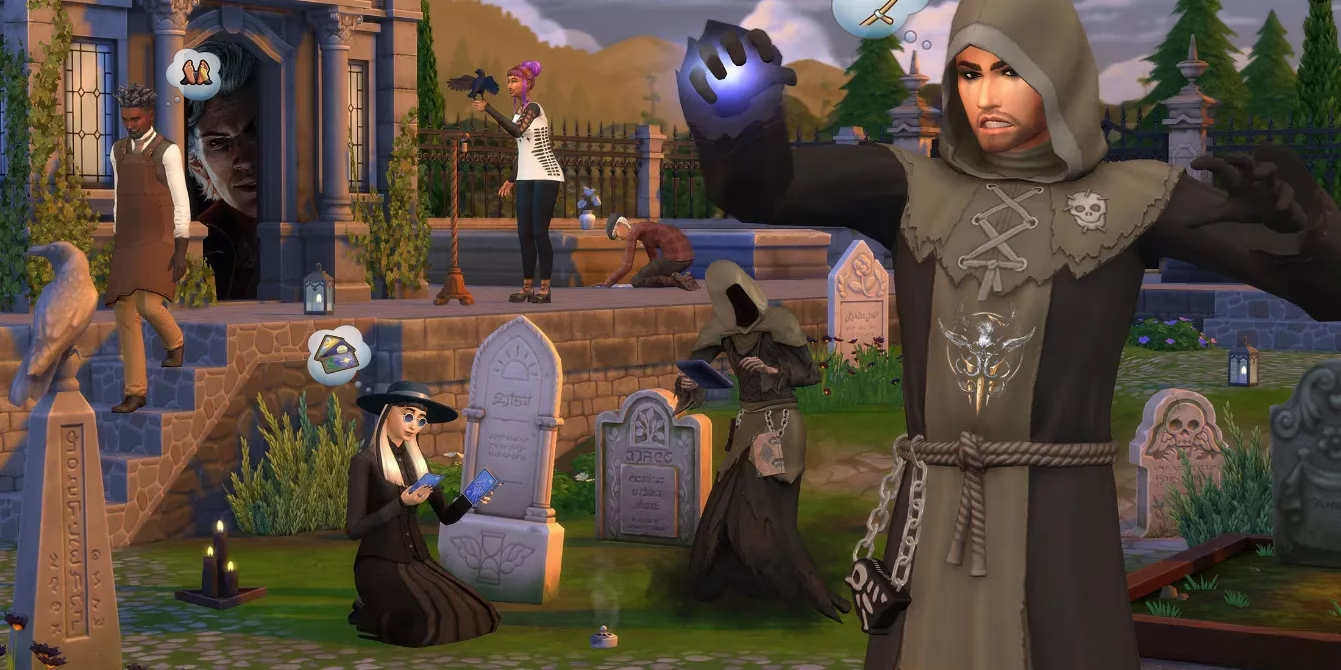
Winter 2026 had settled over the gaming world like a familiar blanket, and for many, the holiday break meant diving back into beloved digital sandboxes. For Lena, a longtime player of both sprawling RPGs and cozy life sims, her return to The Sims 4 after months away was less a replay and more a pilgrimage. She had just spent two hundred hours in Baldur's Gate 3, navigating the perilous Sword Coast and forging bonds with companions whose digital souls had left a permanent mark on her heart. Unbeknownst to her, that Faerûnian journey was about to bleed into the sunny suburbs of Willow Creek in a way she never expected.
It started innocently enough. Lena was tinkering in Build and Buy Mode, that bottomless toy box of creativity, scrolling through the macabre graveyard offerings from the Life & Death expansion pack. The expansion, which had launched back in October 2024, was still a favorite for its gorgeously gothic aesthetic. Her mouse hovered over a headstone titled “Sun and Stars Headstone,” a slab of stone adorned with a simple celestial motif. She clicked it, intending to place it, but her eyes flicked to the item description—a habit she had picked up over the years, knowing that the developers at Maxis tended to weave little tapestries of humor into the most mundane object descriptions. The text read: “This headstone marks the final resting place of a vampire who died from the full concentrated power of the sun! Oh, darling, what a tragedy.”
The words hit her like a thunderbolt. Darling. Full concentrated power of the sun. It was as if a ghostly elf had stepped off the screen of her D&D adventure and into her building simulator. Those lines were unmistakably the signature voice of Astarion, the vampiric rogue whose velvety sarcasm had defined her Baldur's Gate 3 playthrough. Her heart did a little sideways jump, the same kind of thrill an archaeologist feels when a trowel clinks against a shard of pottery that reshapes an entire historical narrative.
Lena wasn't alone in her discovery, of course. The Sims community had unearthed this Easter egg within hours of the expansion’s release in 2024, but for her, finding it organically in 2026 felt like discovering a hidden message in a bottle floating on a digital ocean. The “Sun and Stars Headstone” belonged to a rich tradition of Sims objects that double as love letters to pop culture. Unlike the more direct puns—such as the “We Didn’t Start the Fire Sign” from Get to Work, which wore its Billy Joel reference on its sleeve—this headstone was a stealthy whisper. Its name revealed nothing; only the description, a sly monologue, gave away its true allegiance. It was a masterclass in the art of the Easter egg, akin to seeding a secret garden behind a plain stone wall.
The description itself is a patchwork of Astarion’s most iconic moments. The phrase “full concentrated power of the sun” is a direct quote from a chaotic scene in Baldur’s Gate 3 where, if players try to steal the Blood of Lathander without the proper ritual, the entire monastery comes crashing down. Should Astarion perish in that disaster and then be resurrected back at camp, players can speak with the flustered vampire. In his typical melodramatic fashion, he laments that while he can handle a bit of daylight, he cannot withstand the full concentrated power of the sun. The delivery, full of theatrical indignation, turned the line into a beloved meme among fans. To see it inscribed in a Sims graveyard was to see a character transcend the boundaries of his original game, becoming a immortal cultural sprite.
And then there is the word “darling.” That single term of endearment, dripping with performative charm, is Astarion’s trademark. In Baldur’s Gate 3, he deploys it constantly, whether you’re his closest ally or just a convenient blood bag. Its presence in the headstone’s description took the reference from a general vampiric joke to a laser-targeted message. The community later learned that the Easter egg had been lovingly planted by Molly “SimGuruNova” Narkis, one of the game’s producers. Her confession was like a magician revealing a trick, only to hint that another card was hidden somewhere in the deck. Narkis teased that a second Baldur’s Gate 3 reference was buried in the Life & Death expansion, sending players into a frenzy of collaborative puzzle-solving.
Since then, the hunt has become almost folkloric. In the raven-themed motifs, players searched for Orin the Red. In the tombs and mausoleums, they sniffed for whispers of the Dead Three. Even the darker elements of the pack felt ripe for a visit from a drow like Minthara or a devil like Mizora. The possibility acted like a second ghost, haunting the edges of every black lace curtain and Cadaver Counter kitchen set. By 2026, some sleuths claimed to have found a subtle nod in a potion recipe or a raven’s flavor text, but no definitive, community-wide consensus had cemented a second official Astarion-level revelation. This lingering mystery kept the expansion alive in a way no gameplay patch could.
The cross-pollination between such different genres felt uniquely powerful. The Sims 4 is a narrative generator, a tool for telling stories of mundane glory and suburban tragedy. Baldur’s Gate 3 is an epic saga of fate and fire. Yet here they were, intertwined, the brittle elegance of Astarion lending a drop of dark romance to a space where usually only plumbobs and pool ladders die. Lena, having placed the headstone in her gothic vampire’s backyard, felt a deep, quiet satisfaction. She had not just decorated a lot; she had connected two universes, proving that in the modern gaming landscape, the walls between worlds are as permeable as morning mist. Players like her don't just consume these games—they inhabit them, carrying beloved stories from one realm to another, one headstone at a time.