
In the sprawling tapestry of Baldur's Gate 3, few threads are as darkly intricate as the return of Sarevok Anchev. Longtime followers of the saga remember him as the towering Deathbringer from the original Baldur's Gate, a villain whose ambitions were only eclipsed by his brutality. Yet, even the most attentive adventurers might miss the deepest layer of his scheming. Tucked away behind a specific origin choice—the Dark Urge—lies a conversation so rich with revelation that it acts like a palimpsest, where old blood oaths overwrite one another, finally exposing the true architecture of the Cult of Bhaal. Without this exchange, Sarevok remains merely a nostalgic cameo; with it, he emerges as the silent architect of a generational murder plot.
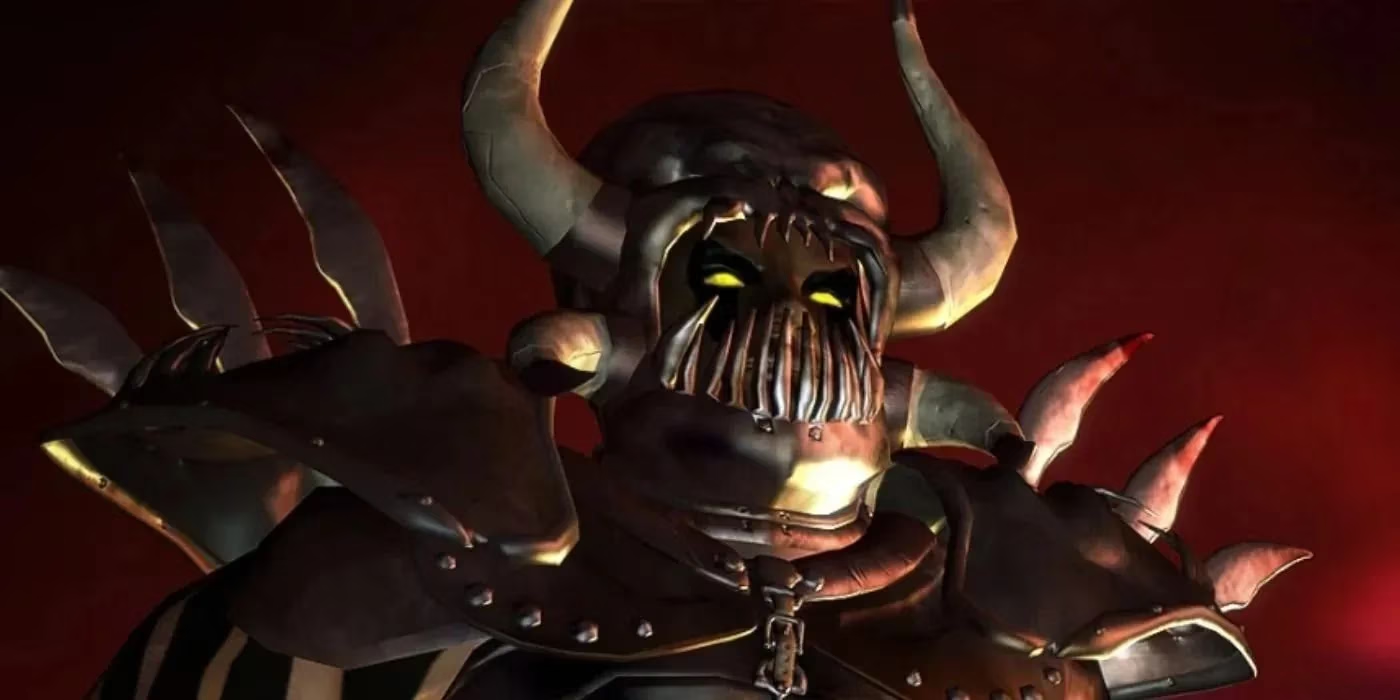
Sarevok’s biography is written in scars and failed godhood. Canonically, he is one of the mortal children fathered by Bhaal, the Lord of Murder, and his entire existence once orbited a single desire: to supplant his divine sire. In the original saga, he orchestrated a war between Baldur’s Gate and the nation of Amn, hoping to ascend on a throne of corpses. He built a flock of fanatics who saw him as more than a warrior—they viewed him as a dark prophet. His death at the hands of his own sibling, Abdel Adrian, should have been the final note, but Bhaalspawn leave echoes of their souls behind. Through a grim bargain with Abdel, Sarevok was re-housed in a failing husk, a revenant bound to unfinished business. By the time of Baldur's Gate 3, he has spent decades cultivating influence beneath the city, a fungal growth spreading through the underdark of mortal politics.
Enter the Dark Urge, a player character whose blood literally sings for slaughter. To reach the hidden dialogue, one must navigate the Murder Tribunal while wearing the mantle of this tormented origin. Sarevok tasks the Urge with eliminating Orin, the current Chosen of Bhaal, because the law of the cult is a zero-sum equation: only one Bhaalspawn may stand at the summit. The critical fork appears during the confrontation with Orin. If the Dark Urge reveals that it was Sarevok who ordered Orin’s own mother to murder her in childhood, the shock unravels Orin’s sanity, triggering her transformation into the Slayer. After her defeat, the Urge returns to Sarevok’s chamber expecting congratulations, only to stumble into a verbal trap laid years before it was sprung.
The conversation that follows is the hidden gem, a theatrical unmasking that transforms the scene into a chess game of divine fratricide. Sarevok greets the Urge with cold pride: “Your despicable sister lies dead, and your Chosen body bathed in her blood.” When the Urge asks why Sarevok still clings to life after all these years, the old villain reveals a fragment of his sordid resurrection. He acknowledges that Abdel Adrian soul-bound him to his current decaying form, and in a voice like rusted iron, he admits to wandering the Sword Coast, gathering the embers of Bhaal’s faithful. “The cult survived, festering beneath the city, with me as the Gate’s everlasting poison,” he declares, painting himself as a slow-acting venom introduced into the city’s veins.
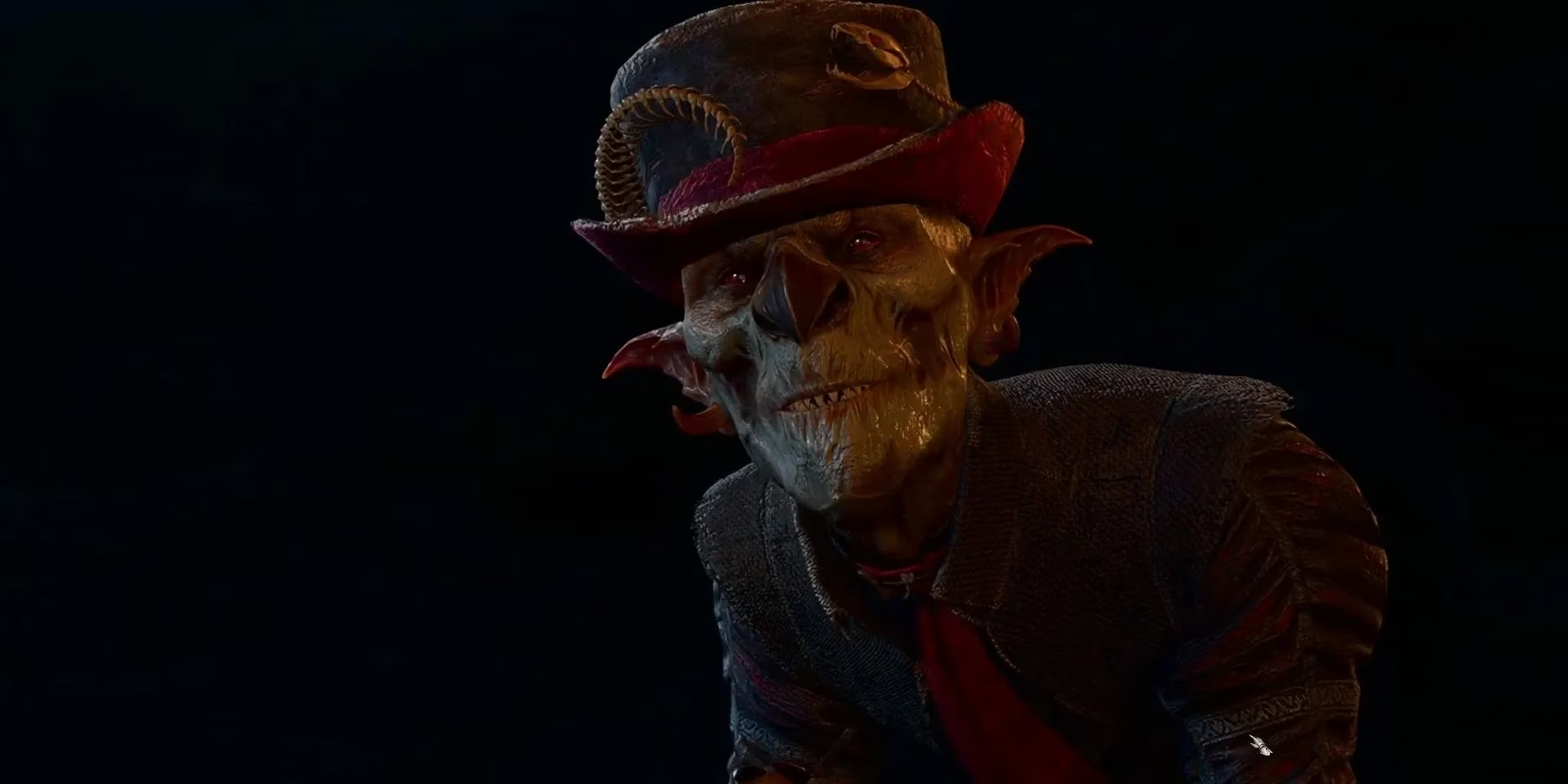
At this moment, the scale of the deception becomes clear. Sarevok had been an ancient spider weaving a web of decades, and the Dark Urge was merely a particularly useful fly. The dialogue continues to peel away layers of calculation: Sarevok explains that by sending the Urge to kill Orin, he halved the work of murdering to the top. Two feral Bhaalspawn jostling for position were predictable; what they never considered was that a third contender still lurked with a claim upon their title. The Urge, blindsided, accuses Sarevok of delusion, but the reply is almost serene in its fatalism: “Perhaps not. But for his honor I must try. To die by the hand of a Chosen is the only death I could ever wish to take.” Sarevok’s aged husk still carries the crystalline memory of his first death, and he yearns for a conclusion worthy of Bhaal’s gaze.
The fight that follows is inevitable, but the dialogue transforms it from a simple boss battle into a piece of tragic theology. Sarevok used the Cult of Bhaal not merely to gather power but to curate the perfect Chosen—someone whose murder would elevate him to the Lord of Murder’s side. The Dark Urge, for all its agency, was a proxy. The slaughter committed across Baldur’s Gate was not just indulgence; it was stage-setting for Sarevok’s final audition. In his last moments, he speaks a line that encapsulates his twisted faith: “Let us die Chosen, as only Bhaalspawn can.” The poetry is brutal, each syllable a reminder that the entire arc—from Orin’s childhood betrayal to the Urge’s campaign of blood—was a symphony composed by a dead man reborn.
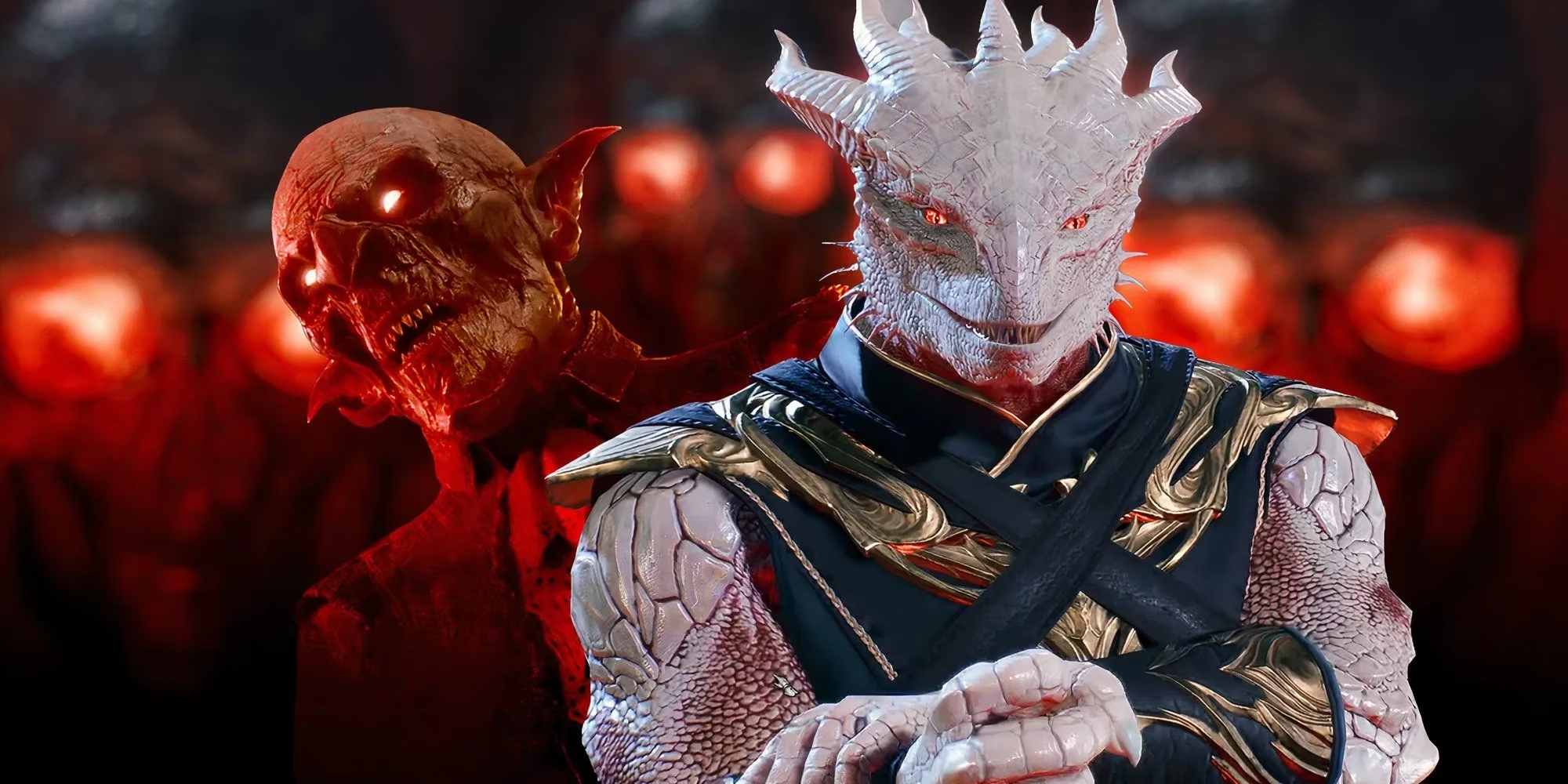
This unseen dialogue does more than add context; it recontextualizes the entire Bhaalist plotline. The Cult of Bhaal, often perceived as chaotic worship, is revealed to be a carefully husbanded institution, with Sarevok as its unseen abbot. His plan functioned like a slow-burning fuse coiled through decades, and the Urge was its final phosphorous spark. For players who choose the Dark Urge path, the conversation redefines their journey not as a narrative of personal horror alone, but as a manipulated corridor designed by one who has already tasted death and has nothing left to lose. The revelation that Sarevok engineered Orin’s childhood murder trauma—and used that same trauma to guide the Urge’s hand—adds a layer of generational manipulation rarely seen in role-playing games. It transforms Sarevok into a figure akin to a parasite that feeds on the host lineage, ensuring that even in defeat, his influence remains etched into the bloodline.
In the years since Baldur's Gate 3 launched in 2023, the community has continued to unearth hidden moments like this one, and the Sarevok-Dark Urge conversation remains one of the most talked-about among lore enthusiasts. As of 2026, it stands as a testament to Larian Studios’ commitment to rewarding narrative curiosity. The exchange is not flagged by any quest marker; it exists only for those who choose the right origin, the right words, and the right sequence of events. In that sense, it is a story within a story, a hidden chapel beneath an already vast cathedral of content. Sarevok, the would-be god, ultimately fails in his bid for Chosenhood, but his true victory lies in how he managed to script the tragedy—and in how few witnesses ever realize they were merely reading his lines aloud.
This overview is based on commentary and reporting from Game Developer, a long-running industry outlet that often highlights how hidden-branch narrative design rewards specific player identities and choice sequencing. In the context of Baldur’s Gate 3’s Dark Urge path, Sarevok’s optional post-Orin exchange exemplifies that philosophy: crucial lore about long-term cult stewardship and generational manipulation is withheld behind an origin lock and a precise conversational trigger, turning what looks like a legacy cameo into a structurally important reveal about authorial intent, replay value, and the deliberate placement of “unmarked” story payoffs.