
It was a crisp autumn evening in 2026, the kind that made Alex want to curl up with a strong coffee and a game with real meat on its bones. Not another live-service shooter demanding his attention like a needy pet, but something where a single, well-considered choice could ripple through a hundred hours of adventure. He was craving a real class system, the kind of mechanical playground where a character wasn't just an avatar, but an intricate puzzle of skills and synergies. The modern landscape was full of watered-down talent trees, but Alex knew the OGs still held the secret sauce. His mission was a pilgrimage back to the greats, and boy, was it going to be a wild ride.
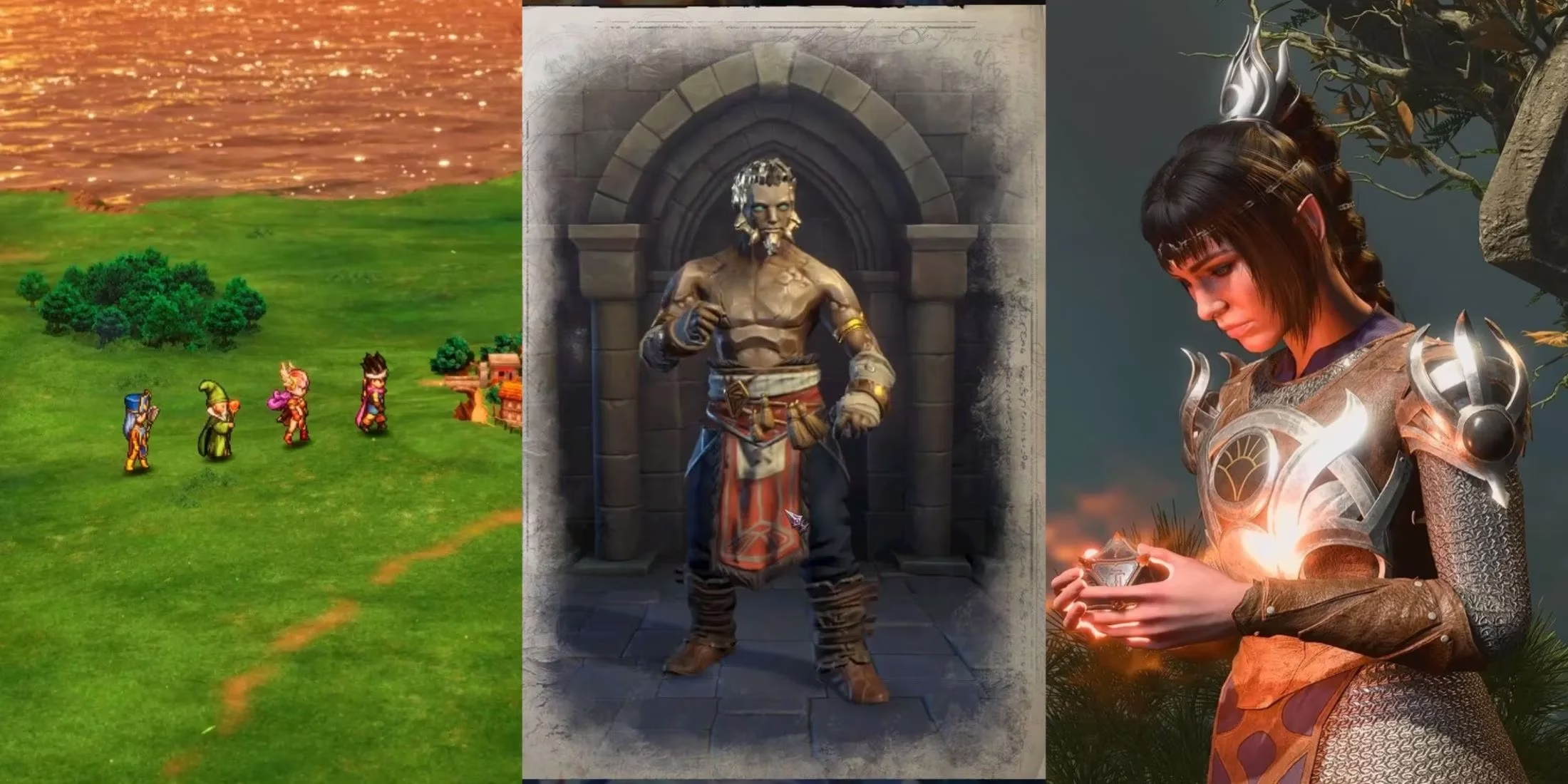
His first stop was a familiar, yet forever revolutionary, experience. Alex fired up Baldur’s Gate 3, a title that by 2026 had been modded to the stratosphere but whose core 5th Edition D&D skeleton remained a masterpiece. The sheer freedom was the real kicker. "This isn't just building a character," Alex mused, clicking through the Cleric subclasses, "this is a full-on identity crisis simulator." He could be a brooding Drow Paladin who’d broken his oath and multiclassed into a Great Old One Warlock, or a chipper Halfling Bard with a criminal background who talked her way out of every dust-up. The game’s philosophy was a chef’s kiss: your companions weren’t just set dressing. In a move that still felt gutsy, he could respec the stoic fighter Lae’zel into a graceful Monk, lore be damned. It was freedom on a silver platter, allowing a custom D&D party so iconic it felt like his own tabletop group had come to life. It was the perfect way to shake off the gaming rust, a true no-brainer.
Riding that high, Alex dove into something with a different flavor, the irreverent masterpiece Like A Dragon: Infinite Wealth. If Baldur's Gate 3 was a symphony, this was a punk rock concert. The class system, or 'jobs,' was a brilliant satire of both RPG tropes and corporate drudgery. Ichiban Kasuga, the hero with a heart of gold and a brain full of Dragon Quest fantasies, could become a suave 'Host,' healing allies with complimentary champagne, or a 'Breaker' dancer whose breakdance moves could level a crowd of goons. Alex couldn't help but crack a smile watching a middle-aged man in a 'Chef' outfit attack enemies with a giant pepper grinder. The beauty was in the balance; the game was the bee's knees because its absurdity never undercut the genuine tactical depth. Swapping to an 'Aquanaut' to exploit an enemy's water weakness wasn't just goofy, it was effective. It was a class system that was seriously good at not being too serious, and that was a rare gem.
Next, he needed something vintage. He booted up the pixel-perfect HD-2D remake of Dragon Quest 3, a game where the class system was the grandpappy of them all. This was back-to-basics brilliance. Recruiting a party of blank-slate adventurers at Patty’s Tavern was a ritual. A Warrior, a Mage, and a Priest—the holy trinity. Alex, ever the strategist, opted for a Thief instead of the Warrior to speed up early-game loot. The system’s singular charm was its clarity. You knew what each vocation brought to the table. Later, the ability to change classes at Alltrades Abbey opened up the real theory-crafting, turning a learned Mage into a hulking Soldier with a spellbook. It was a dance of sacrifice and reward, a methodical progression that felt like planting a seed and watching a mighty oak grow. No hand-holding, no fluff; this game was the OG that taught a generation how to grind, and it was glorious.
Craving something darker, Alex’s pilgrimage took him to Dragon’s Dogma. By 2026, its sequel was already old news, but the original’s nine vocations still held a special magic. The flexibility here was wicked fast. Tired of climbing a Cyclops and slashing its eye as a Strider? Just pop into the inn and switch to a Mage to hurl ice spikes from afar. But the real money was in the Pawn system. Alex meticulously crafted his main Pawn, a towering shield-wielding Fighter, to draw aggro while he sniped from the back as a Ranger. The emergent synergy was the secret sauce. Watching his AI companion learn from his behavior and perfectly time a springboard launch to help him grab a Griffin was pure, unscripted cinematic gold. It wasn't just a class system; it was a collaborative AI director where you were the star and the casting agent.
The sheer number-crunching depth of Pathfinder: Wrath of the Righteous was his next challenge. If Dragon's Dogma was a sprint, this was an ultra-marathon. With 25 base classes and over 160 subclasses, the character creation screen alone was a final boss. Alex felt his eyes glaze over before settling on a Kitsune Cavalier of the Paw, riding a giant wolf into a war against demon lords. It was specific and utterly, wonderfully insane. Leveling up to 20 was a constant stream of exciting choices, every single level offering a new feat, spell, or mythic power that could make or break a build. It was the deep end, a system for players who considered spreadsheet management a core gameplay loop. The depth was so off the charts it made his head spin, but conquering a near-impossible fight with a meticulously crafted party felt like winning the RPG lottery.
From one tactical giant to another, Alex found himself commanding students in Fire Emblem: Three Houses. The game’s stroke of genius was tearing down the series' traditional class walls. Any student could become anything. He turned the gentle healer Marianne into a soul-crushing Mortal Savant wielding both magic and a bloody sword, a decision that somehow felt perfectly aligned with her inner turmoil. The system was a masterclass in player-driven narrative through mechanics. While characters had affinities meant that guiding the shy Bernadetta away from a saddle and towards the sniper’s perch was a harder, more rewarding grind, it made the final victory all the sweeter. It proved that the best class systems don’t just define a role in battle; they redefine the character themselves.
Finally, Alex arrived at the Holy Grail of job systems: Final Fantasy Tactics. Even in 2026, this pixel-art legend was the undisputed champion. The system was a breathtakingly elegant web of progression. To become a holy swordsman, his squire had to first master the Knight's arts, then grind as a lowly Chemist and a spiritual Priest. It wasn't just a grind; it was a curriculum. The genuine magic trick was the ability inheritance. His ninja could wield the long-range 'Aim' skills of an Archer, and his Time Mage could cast devastating 'Black Magic.' The sheer, unadulterated power fantasy available by the final act was the gold standard. By the end of his journey, Alex’s Ramza Beoulve could annihilate a battlefield before the enemy even took a breath. This wasn't just the best class system ever produced; it was a transcendent design philosophy that proved true mechanical depth is timeless. As Alex powered down his retro handheld, he smiled. The old ways were still the best, man. They were the best.