
It was a crisp spring evening in 2026 when the Baldur's Gate 3 community lit up like a goblin camp doused in Alchemist's Fire. Larian Studios had just dropped the long-awaited Patch 8, billing it as the final major update to their genre-defining RPG. Alongside photo mode, cross-play improvements, and a host of bug fixes, the star of the show was a gift no one had truly expected: twelve brand-new subclasses, one for each base class. For Warlock devotees, the addition was especially tantalizing—the Hexblade, a patron option steeped in D&D 5th Edition legend and whispered about on forums for years, had finally arrived.
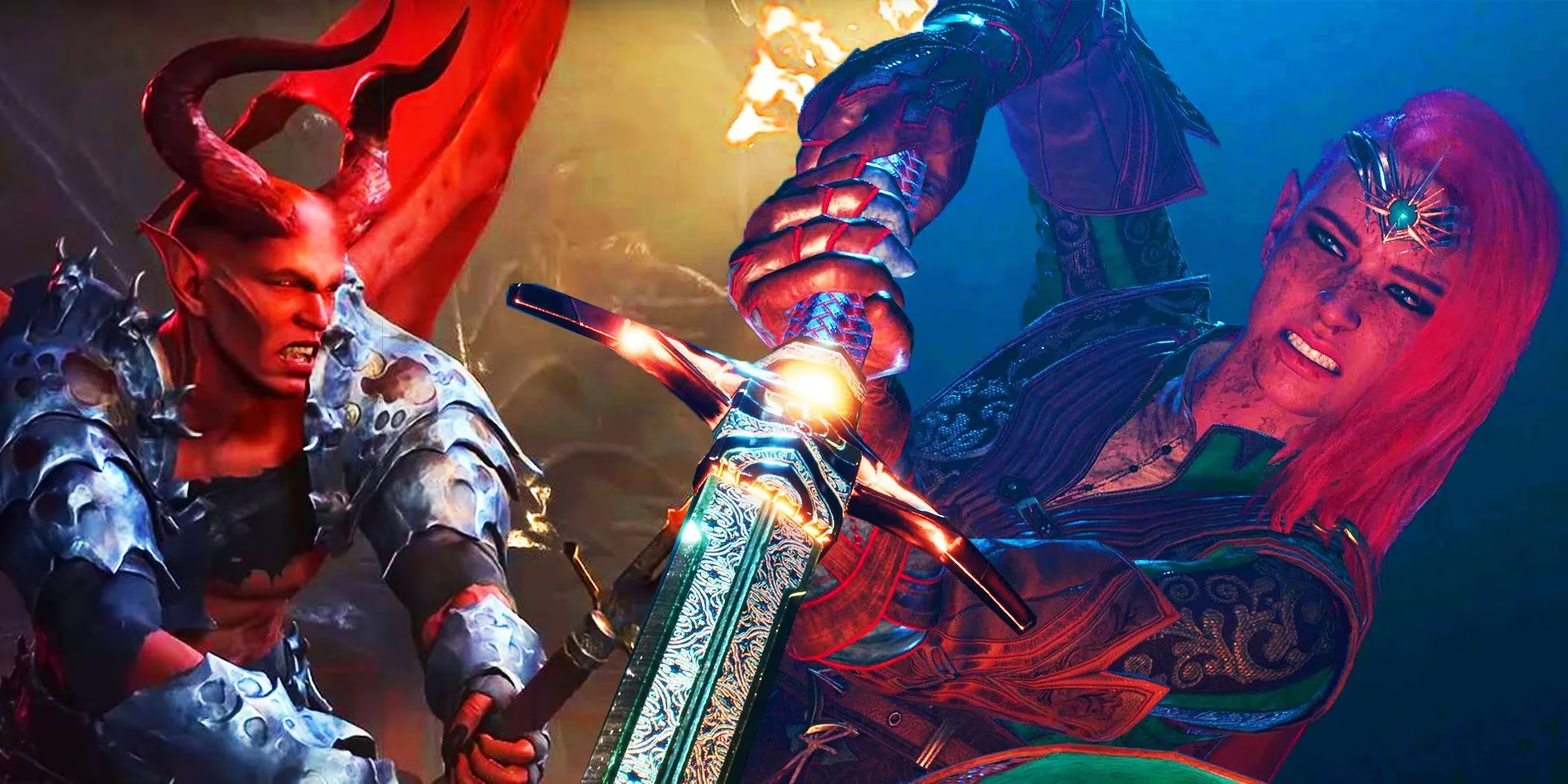
Players who had built entire campaigns around a single-class spellblade fantasy clutched their enchanted dice. After all, the Hexblade wasn't just another subclass. In tabletop circles, it was the gold standard of the “spellblade” archetype—a warrior who attacks with Charisma instead of muscle, curses enemies into oblivion, and laughs at the very notion of a weak melee Warlock. But in 2026, on the digital battlefields of Faerûn, a quiet anxiety was already creeping through the tavern chatter. Could the Hexblade still feel special when one of its most defining tricks had already been handed out to every Warlock in the game?
The Echo of a Curse Already Lifted
To understand the tension, one must rewind to the Baldur's Gate 3 launch era. Back then, the Pact of the Blade feature was a promise of power, but not the whole picture. At level three, any Warlock could conjure a magical weapon and become proficient with it. Then came subsequent patches—sharpening their pact, adding Extra Attack, and crucially, making weapon attacks scale off Charisma instead of Strength or Dexterity. Sound familiar? In tabletop, that exact privilege is called Hex Warrior, and it was the cornerstone of the Hexblade's identity. A one-level Hexblade dip had famously turned countless Paladins and Bards into untouchable demigods who only needed one ability score: Charisma.
Now, in 2026, a player could stand before a goblin with any Warlock—be they Fiend, Archfey, or Great Old One—and smite it with a longsword using their silver tongue, not their biceps. The Hexblade's secret sauce was no longer secret. So what does the newcomer bring to the table? Is the subclass destined to be a pale shadow of its tabletop self, or will it rise as something entirely new?

What’s Left of the Spellblade King?
If you ask a veteran dungeon delver what makes a Hexblade a Hexblade, the answer usually goes beyond Charisma attacks. The real star of the show is the Hexblade's Curse. Plant it on a boss, and suddenly your weapon attacks score critical hits on a 19, your damage rolls pump up with your proficiency bonus, and the death of that target showers you in healing energy. That feature remains untouched, and it’s a tremendous tool. In the tight, tactical combat of BG3, a reusable, short-rest-reset curse that amplifies both weapon and spell attacks is enough to build an entire build around.
But Larian isn't simply copying the Player's Handbook. The sixth-level ability, Accursed Specter, which traditionally lets the Hexblade raise a slain enemy as an undead servant, feels thematically perfect but mechanically crowded in a game already brimming with summons. This is where the community’s collective imagination runs wild. What if Larian redesigned that feature to double down on melee prowess? Imagine after killing a cursed enemy, your weapon gains an aura of necrotic energy, causing subsequent hits to drain life or inflict vulnerability. Or perhaps the Hexblade in BG3 gains a unique fighting style, letting them replace an Eldritch Blast beam with a spectral sword slash—a ranged melee attack that feels both magical and martial.
The table below compares what was old (tabletop) and what might be new (BG3 2026):
| Feature | Traditional Tabletop (5e) | Speculated BG3 Implementation (2026) |
|---|---|---|
| Level 1: Hex Warrior | Charisma for weapon attacks, medium armor, shields | Partially absorbed by Pact of the Blade; might instead grant immediate Blade Pact benefits plus unique weapon buffs |
| Level 1: Hexblade’s Curse | Bonus action curse; crit on 19, bonus damage, heal on kill | Likely remains intact, possibly with improved scaling to compete with Eldritch Blast builds |
| Level 6: Accursed Specter | Raise an undead specter from a slain humanoid | Reworked in BG3? Could become a “Hexed Weapon” state that triggers after kills, adding necrotic damage or life steal |
| Level 10: Armor of Hexes | Reaction to turn a cursed enemy’s hit into a miss | Strong defensive tool that would fit beautifully into BG3’s reaction system without changes |
| Level 14: Master of Hexes | Move the curse from a dead target to a new one | Potentially game-breaking if kept, so might be toned down or limited to once per turn |
The Elusive Spellblade Fantasy
To be fair, before Patch 8, no existing Warlock subclass in Baldur's Gate 3 truly rewarded swinging a sword. The Fiend gives temp HP on kills, but a Mage Hand scroll does the same work without risking your d8 hit dice. The Great Old One frightens on critical hits, but you can proc that safely from a distance. The Archfey charms and escapes. All of them can take Pact of the Blade and become competent melee fighters, but none of them celebrate the act of hitting something with a magic sword the way a Hexblade should.
That’s the gap Larian must fill. The question isn't “Can the Hexblade still swing a sword?” but “Why does the Hexblade’s sword feel different?” The answer might lie in hyper-synergy with the pact weapon. Imagine if, as a Hexblade, your summoned weapon automatically inflicted the Hex spell on targets without concentration. Or if your pact slots could be burned to empower a single mythic strike that cleaves through magical defenses. Suddenly, the class isn't just a Paladin with fewer spell slots—it becomes a nova-damage duelist who warps the battlefield around a single, accursed adversary.
Community Reactions: Blessing or Curse?
Across forums, Discord servers, and YouTube comment sections in early 2026, the mood is a mix of nostalgia and nail-biting anticipation. Some players argue that the Hexblade doesn’t need to be the de facto best melee Warlock—it just needs to be the most focused. After all, the existence of Pact of the Blade for everyone means a Hunger of Hadar-loving Fiend Warlock can still pick up a rapier without feeling useless. The Hexblade, then, could be for the purist who wants every ounce of their character sheet tuned toward martial perfection.
Others worry about power creep. With Larian’s history of inventive homebrew, the Hexblade could easily become the new meta bane of Honour Mode. Will we see Hexblade/Sorcerer multiclasses that dodge everything while landing criticals on a 15? Or will Larian implement the subclass with such finesse that it feels like a natural, balanced evolution of the Warlock toolkit? Given the studio’s track record—remember how they handled the Artificer mod integration and the improved Oathbreaker systems—confidence runs high. But the lingering whisper remains: in a world where any warlock can be a blade-wielder, can the Hexblade still be a curse worth bearing?
Perhaps the most exciting prospect is what the Hexblade’s arrival says about Baldur's Gate 3’s enduring legacy. In 2026, three years after its explosive launch, the game isn't just surviving on life support—it’s receiving subclasses that spark complex, passionate debates about design philosophy. That’s the sign of a masterpiece that continues to unfold, one patch at a time. Whether you’re a power-gamer chasing the highest DPR rotation or a roleplayer crafting a tragic knight bound to a sentient shadow-blade, Patch 8 promises to make you look at your Warlock with fresh eyes.
So, as servers update and players load into the character creator once more, the real question isn't about what the Hexblade lost. It’s about what it can become. And if Larian’s history proves anything, the answer will be far more than just a nostalgic homage—it will be a reinvention that makes the sword sing once more.