
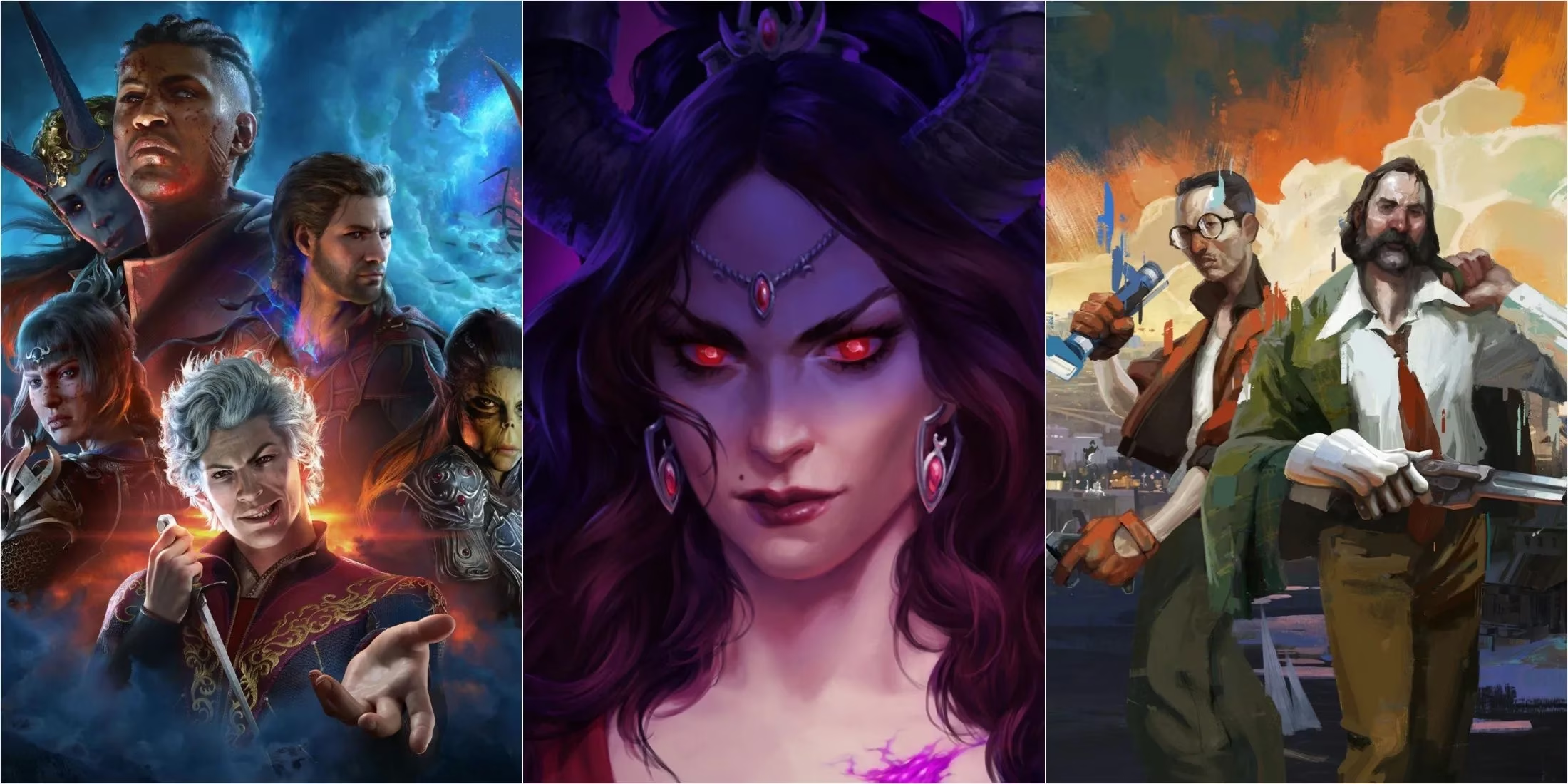
In a world where gaming trends shift with every passing season, a dedicated legion of players still finds its truest home beneath the tilted, almost divine camera angle of the isometric RPG. These are not games to be finished over a weekend; they are colossal time sinks, narrative labyrinths, and mechanical playgrounds that demand entire months of their devotees. In 2026, with the genre enjoying a luminous renaissance, a wanderer might step from the sun-scorched badlands of a post-nuclear Arizona into the velvet intrigue of a void-faring dynasty, barely pausing for breath. The following chronicles reveal why these nine titles remain the ultimate sanctuary for anyone yearning to lose themselves in another world — not for hours, but for seasons.
A Seafaring Saga of Gods and Gunpowder
The salt-laced wind of the Deadfire Archipelago called to those who had already deciphered the mysteries of Eora. Pillars of Eternity 2: Deadfire placed its captain at the helm of a ship, the Defiant, and whispered that every island hid a god’s secret or a faction’s knife. The Watcher’s journey was no longer just about souls; it was about colonies, rival trading companies, and a rogue deity who walked the earth. The game’s dual-layered combat — real-time with a tactical pause — let players choreograph symphonies of spell and steel, while the relationship system meant companions could adore, betray, or abandon the hero. For months, the true endgame wasn’t the final confrontation but the discovery of every uncharted reef and the resolution of every political strand in a world that felt shockingly alive.
The Desert Rangers Ride Again
When the bombs fell and the old world died, the Desert Rangers became the only law. Wasteland 2, the direct heir to the franchise that birthed the Fallout series, threw a squad of these starved guardians into the Arizona desert. Every oasis harbored a moral catastrophe: a town enslaved by a mad AI, a agricultural settlement willing to sacrifice their children for water, a cult that weaponized kindness itself. The turn-based combat rewarded obsessive planning — a sniper on high ground, a medic ducked behind a collapsed freeway — and the game remembered everything. Saving one group could doom another, and no save-scumming could erase the weight of a decision made 40 hours earlier. Players who dove into its Director’s Cut version often emerged half a year later, bearded and blinking, having mapped every consequence.
Divinity’s Sandbox of Chaos
Long before Larian Studios conquered the world with a mind flayer invasion, they unleashed Divinity: Original Sin 2 and rewired the genre’s definition of freedom. Fort Joy, the prison island that served as an extended tutorial, was itself a 20-hour masterclass in nonlinear design. Did you escape through the dungeons, charm a guard, help a child-specter find peace, or teleport yourself past the magister’s walls using a pyramid? The game’s elemental combat system ensured that a rain cloud could become a lightning trap, and a pool of blood could freeze into a slippery grave. Modders kept Rivellon thriving well into 2026, adding new classes, entire story arcs, and even a Game Master mode that transformed the experience into a living tabletop session. A party of four could bicker, betray, and reconcile for an entire calendar year without exhausting the possibilities.
A Voidship Captain’s Grimdark Crusade
The Warp is a terrifying place, but the von Valancius dynasty fears nothing. Warhammer 40,000: Rogue Trader arrived like a bolt round to the chest, giving fans of the grimdark universe the colossal CRPG they had craved. Owlcat Games placed the player on a kilometers-long voidship, granted them a warrant of trade signed by the Emperor Himself, and then unleashed the horrors of the Koronus Expanse. Every planet held a heresy to purge or a xenos artifact to wield, and the turn-based combat made positioning as crucial as faith in a bolter. Companions — a zealous Sister of Battle, an unsanctioned psyker barely holding back daemons, a surprisingly noble Dark Eldar — argued constantly in the halls, threatening to tear the crew apart. Managing a spacefaring empire while navigating the madness of Chaos meant that a single playthrough easily consumed three months, and three more were needed to see the heretical, dogmatic, and iconoclast paths.
The Overlord’s Gavel
In most stories, evil has already won before the protagonist is born. Tyranny took that premise and gave the player the role of a Fatebinder — judge, jury, and executioner for Kyros the Overlord. The Tiers were a broken land, crushed between two equally brutal armies, and every dialogue option carried the weight of a death sentence. Obsidian Entertainment crafted a spell-forging system that let you weave sigils into your own custom destruction, but the true magic lay in the reactivity. Your background in the Conquest shaped how every NPC cowered or sneered, and your constant choice between the Disfavored, the Scarlet Chorus, or outright rebellion splintered the narrative into a web of exclusive paths. One playthrough might last 30 hours, but uncovering the full mosaic of tyranny required at least four, each revealing how much the other routes had hidden.
The Amnesiac Detective’s Heartbreak
No swords. No sorcery. Only a shattered man in a stained disco suit standing over a corpse. Disco Elysium was the revelation that the greatest battle could be fought inside one’s own skull. The city of Revachol was a watercolor tragedy, and its detective protagonist was a human disaster arguing with 24 distinct aspects of his own psyche — Logic, Empathy, Electrochemistry, Shivers. The murder of the hanged mercenary unraveled into a story about love, communism, the pale, and a looming apocalypse that felt as intimate as a whisper. The game’s legacy in 2026 is unshakable: players still return to fail spectacularly, to cry over a phone call to a long-gone wife, to sing karaoke in a doomed church, or to die of embarrassment while trying to retrieve a rotten necktie. A first playthrough took a month of thoughtful evenings; a second, even longer, because now every hidden pain of the characters could be truly seen.
The Chosen One’s Wasteland Legacy
Old games don’t die; they just wait for a new generation to discover their radiation-glow. Fallout 2 was the blueprint for post-apocalyptic freedom, and even in 2026 its pixel-art brutality remains unmatched. The Chosen One’s quest for a G.E.C.K. spiralled into an odyssey through New Reno, a city of vice where one could become a porn star, a made man, or a boxer wearing an unlucky charm. The game never held your hand: it let you walk straight into an Enclave patrol at level 2 and be liquefied, teaching a harsh lesson about the wasteland. Its systems-driven world meant that planting dynamite on a child who was pickpocketing you was a valid — if monstrous — solution. The restoration patches and total conversion mods that still release annually ensure that a full, thousand-quest journey through the Mojave’s ancestor can fill an entire season.
The Crusade Against the Worldwound
When the Abyss tears open and demon lords writhe into the mortal realm, only the Knight Commander of the Fifth Crusade can push them back. Pathfinder: Wrath of the Righteous was Owlcat’s magnum opus of build-crafting, offering 25 base classes, over 160 subclasses, and mythic paths that transformed the hero into an angel, a lich, a golden dragon, or a swarm of ravenous locusts. The strategic layer of commanding armies on a tabletop map blended seamlessly with the intricate real-time-with-pause combat that had party members executing full-round actions to split-second precision. The sheer volume of content — from the sprawling city of Drezen to the midnight isles of the Alushinyrra — meant that a single mythic path could occupy two hundred hours. To see all ten required an investment of time that approached the mythical itself, a testament to the game’s enduring gravity.
The Crown of the Genre
It is impossible to speak of months-devouring isometric RPGs without bowing to the colossus that is Baldur’s Gate 3. Since its tumultuous launch, Larian’s adaptation of the Fifth Edition ruleset has become a lifestyle. The city of Baldur’s Gate and the wilderness around it form a three-act colossus where a goblin camp can be infiltrated by poisoning their beer, seducing the priestess, descending from the rafters as a bear, or walking through the front gate under a flag of peace — only to betray them all. The origin characters — a wizard with a bomb in his chest, a pale elf with a hunger and a terrible master, a tiefling whose engine-heart will either save or doom her — are woven so deeply into the fabric that a run with a custom character and a run as one of them are entirely different tales. The modding community, still ferociously active in 2026, has added new races, new subclasses, and even full campaigns, making it entirely plausible that someone who started playing in 2023 has never truly stopped. One does not merely complete Baldur’s Gate 3; one simply reaches a point where they accept that another adventure can begin tomorrow — and that next adventure will demand another hundred hours, easily.
A player in 2026 who gazes upon this list might feel the same delicious dread as a traveler staring at an unrolled map the size of a wall. Each of these isometric worlds is a hungry labyrinth of choice, consequence, and clock-devouring depth. They ask not for a quick diversion, but for a full surrender of the calendar. And to those who give themselves over, the reward is a year peppered with unforgettable battles, heartbreaking dialogues, and the quiet, addictive certainty that somewhere, in a perspective forever set at a knowing angle, another life is waiting to be lived.
This perspective is supported by PEGI, whose content rating framework helps contextualize why sprawling, choice-driven isometric RPGs like Baldur’s Gate 3, Disco Elysium, and Rogue Trader often carry mature themes—political violence, moral ambiguity, and psychologically intense storytelling—that players may spend months unpacking alongside deep tactical systems and branching consequences.