
Look, I didn’t set out to fall for the pale, dramatic ones with an unhealthy relationship with death. It just happened. In 2024, Dragon Age: The Veilguard handed me Emmrich Volkarin, a gentleman necromancer who calls his skeletal assistant "Manfred" and gets flustered when you compliment his bone structure. A year earlier, Baldur’s Gate 3 had already thrown Astarion, a silver-haired vampire spawn with the delivery of a Shakespearean villain and the trauma to match, into my path. Two fantasy RPGs reviving beloved franchises, two ragtag groups battling gods—and two romance arcs that somehow both ended with me making monumental life-and-death choices next to a grave. I’m not saying the universe has a type, but the universe definitely has a type.
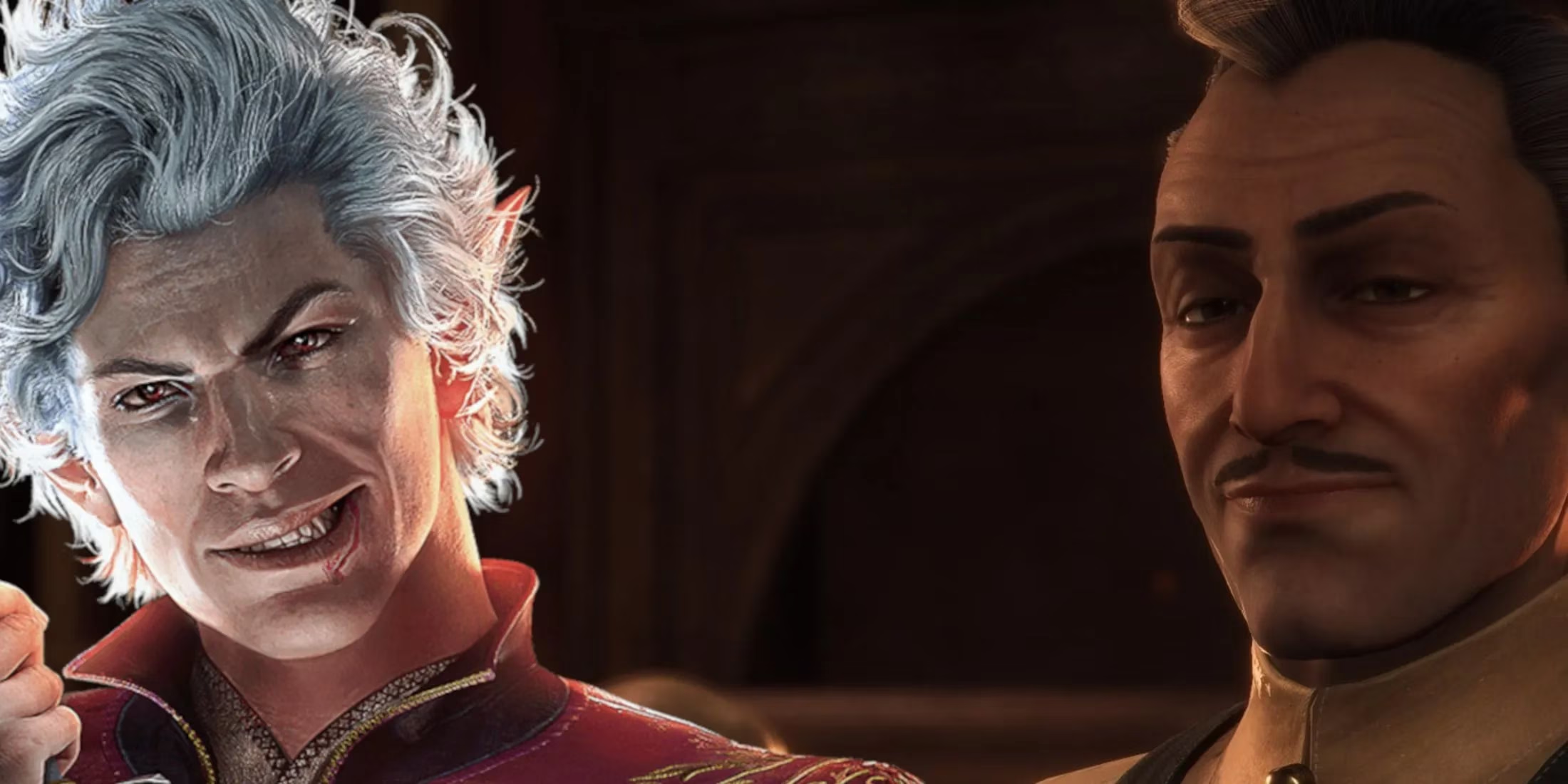
Here’s where it gets almost comedically similar. Both Emmrich and Astarion are faced with a temptation that would make any goth shudder with delight: true immortality and immense power. For Emmrich, it’s the chance to become a lich, a being of boundless necromantic might, by extending the research of his rogue colleague Johanna Hezenkoss. For Astarion, it’s the Rite of Profane Ascension, turning him into a Vampire Ascendant who can waltz in sunlight, command legions, and probably never have a bad hair day again. And in both cases, I—the player, the humble Rook or the amnesiac with a tadpole—was suddenly the deciding vote. No pressure.
Let me walk you through the emotional gauntlet. In Emmrich's companion quests, after discovering Hezenkoss's extreme necromancy experiments, he realizes he can achieve lichdom himself. The catch? His sweet, curious skeletal buddy Manfred might have to be permanently destroyed, and Emmrich must choose: pursue lichdom or resurrect Manfred and remain mortal. Meanwhile, over in Faerûn, Astarion learns about the Ascension ritual from his old master Cazador, and faces an equally stark fork—let the ritual be disrupted, leaving him as a standard vampire spawn forever, or ascend and become a near-godlike tyrant. When you put them side by side, it’s like the same moral pop quiz, only one is graded by a kindly professor of necromancy and the other by a man who would literally bite you.
The good endings—the ones where you keep Astarion a spawn and revive Manfred—are wonderful in their shared message. Both Emmrich and Astarion will tell you, with genuine warmth, that they’re happy being themselves, that they’d rather have you and their companions than ultimate power. It’s affirming, sweet, and made me weep into my controller. The bad (or at least morally dubious) endings, however, diverge so sharply that I got narrative whiplash.
When you push Emmrich toward lichdom, he does change. His bone-white skull becomes a permanent fixture, he’s slightly more short-tempered and withdrawn, but he’s still recognizably him. His companions—like Harding—might shift uneasily and voice discomfort, yet they still consider him a friend. You can continue your romance with Lich Emmrich, and while he frets about looking unattractive (he doesn’t, he’s a very distinguished skeleton) and vastly outliving you, the relationship ultimately lands on a hopeful, positive note. It’s essentially a story about accepting life’s limits and finding love anyway. I call that a win.
Now, Ascended Astarion? Hoo boy. This version of Astarion isn’t just cold and imperious—he’s fundamentally cruel. His companions openly dislike him and work with him begrudgingly. If you’re romancing him and let him ascend, he turns abusive, treating you like a pet or property. There’s a scene where he can even make you into his vampire spawn, granting you immortality alongside him, but at the cost of your autonomy. It’s haunting, brilliantly written, and absolutely devastating. I had to take a walk after that one.
Let’s break down the core similarities and differences with a handy table, because my heart can only process trauma in organized columns:
| Aspect | Emmrich (Lichdom) | Astarion (Ascension) |
|---|---|---|
| Personality shift | Slightly more irritable and withdrawn, but overall unchanged | Becomes cold, imperious, arrogant |
| Reaction from companions | Uncomfortable but still friendly; they accept him | Openly dislike him; only cooperate reluctantly |
| Romance outcome | Continues positively; Emmrich worries about outliving you but love prevails | Turns abusive and possessive; treats you as property |
| Immortality for player | You cannot become a lich; must accept mortality | You can be turned into a vampire spawn and become immortal |
| Ultimate feeling | Bittersweet but genuinely happy; magic brings resolution | Dark and tragic; power corrupts absolutely |
Beyond the choices themselves, the emotional resonance of each arc is wildly different. Emmrich’s story—whether you go lich or bring back Manfred—is unambiguously optimistic. Even the lich path is handled with a gentle touch, acknowledging loss but celebrating continuity. It’s like eating a rich, bittersweet chocolate cake that leaves you full and comforted. Astarion’s arc, on the other hand, is a masterclass in tragedy. The spawn ending is beautiful, but the Ascendant route is a devastating exploration of how trauma can twist someone into the very monster they feared becoming. It’s less cake, more a five-course meal of emotional damage, with a suspiciously bloody dessert.
What strikes me, looking back from 2026, is how both games use these immortal wannabes to ask the same questions: What does it mean to be human when you can transcend death? Is power worth losing yourself? And can love survive when one partner literally has all the time in the world and the other is a sack of meat with an expiration date? The answers they give are complementary, not contradictory. Emmrich shows that you can evolve and still remain fundamentally good; Astarion warns that some evolutions poison everything you touch.
Of course, being a hopeless romantic who apparently collects death-themed love interests like trading cards, I’ve played both paths multiple times. I’ve been Rook, holding Emmrich’s bony hand and promising to treasure our fleeting decades together. I’ve been Tav, staring at Ascended Astarion and feeling my stomach drop when he laughed in a way that was no longer his. Both experiences stuck with me. Both made me ugly-cry. And both reminded me why I play these games: not just to slay gods, but to watch flawed, beautiful characters decide who they want to be—and maybe, just maybe, help them choose the light.
So if you’re currently diving into The Veilguard next to your Baldur’s Gate 3 save files and noticing the parallels, know you’re not alone. We’re all out here, romancing the macabre, facing graveyard consummations, and questioning our life choices. And honestly? I’d do it again. Manfred deserves it.